How to Set Up EV Charging in Your Apartment Complex in Bengaluru
Learn how apartment residents and housing societies can set up EV charging in Bengaluru, including installation requirements, permissions, costs and safety considerations.
Bengaluru Connect Admin
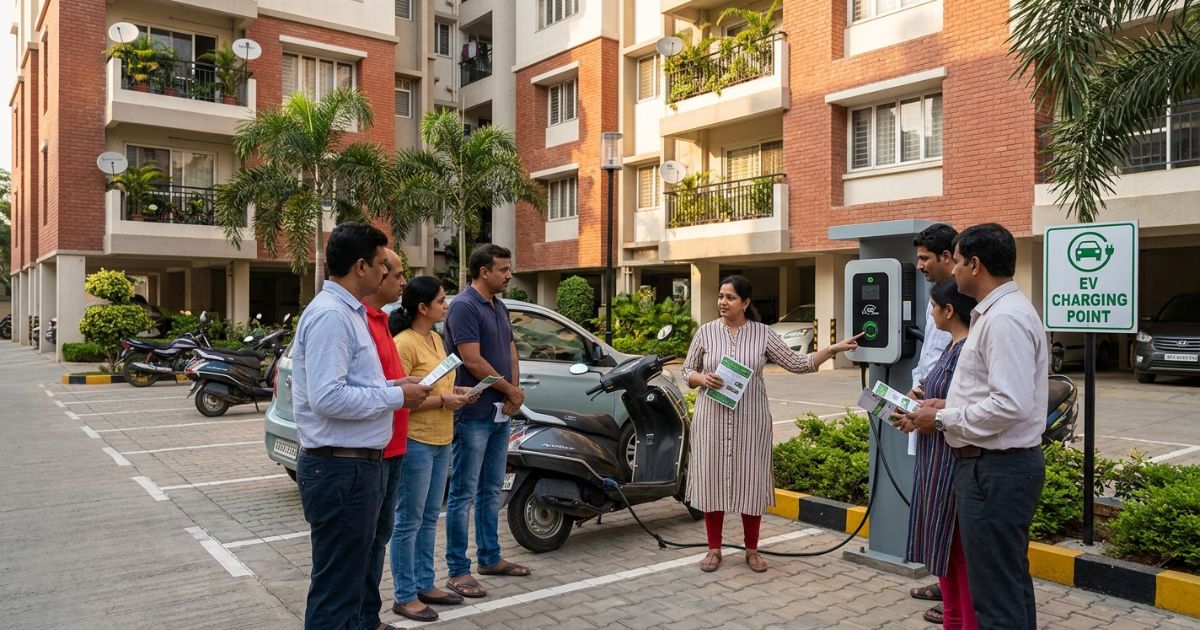
Setting up EV charging in your apartment complex in Bengaluru involves three separate pieces: getting your RWA's approval for the parking and wiring changes, applying to BESCOM for a dedicated EV connection, and choosing equipment and a cost-sharing model that fits your building. None of these steps is especially complicated on its own, but apartment EV charging projects in Bengaluru commonly stall because residents and RWAs approach them in the wrong order usually buying equipment before confirming load capacity, or assuming approval will be a formality. Here's how the process actually works.
Getting RWA Approval for EV Charging in Your Apartment Complex
Parking in most Indian apartment complexes is common property, which means installing a charger even one serving a single flat's allotted spot typically needs your RWA's sign-off before any electrical work begins. The Ministry of Housing and Urban Affairs has clarified that RWAs cannot outright deny a resident's request to install an EV charging point in their allotted parking space, provided the installation meets electrical safety requirements. In practice, most Bengaluru RWAs handle this through a formal request process: submit your vehicle and charger details, get an internal safety and load check done, and receive written approval before contacting an installer or BESCOM.
Where things tend to get contentious is with shared or common-area charging points rather than individual flat installations. Bengaluru has seen real friction between RWAs and EV owners on this front RWAs often want BESCOM or the builder to fund shared infrastructure upfront, while EV owners argue that associations are being overly cautious about a cost that will only grow as more residents switch to electric vehicles. If your building doesn't have shared infrastructure yet, it's worth raising it as an agenda item at the next AGM with a clear cost-sharing proposal, rather than waiting for the RWA to initiate it.
BESCOM's EV Charging Tariff and Connection Process
Karnataka's electricity regulator maintains a dedicated tariff category for EV charging, LT-6(c), fixed under the Karnataka Electricity Regulatory Commission's Combined Tariff Order 2025 at ₹4.50 per unit plus a fixed charge of ₹70 per kW per month, locked in through FY2027–28. That's meaningfully cheaper than a standard low-tension commercial connection, which runs closer to ₹7.00 per unit a large part of why applying for the correct EV tariff category, rather than defaulting to a commercial connection, matters for any apartment setting up shared charging. Note that KERC's April 2026 true-up added a temporary surcharge of 56 paise per unit on BESCOM bills, applicable until April 2027, so confirm the exact current rate before finalising your budget.
Applications for EV charging connections, including for residential and commercial captive use, go through BESCOM's dedicated EV Karnataka portal, with online tracking through to approval. The broad sequence is application submission, an electrical load assessment (to confirm your building's existing infrastructure and transformer can handle the additional load), meter installation, a site inspection, and final approval. This load assessment step is where many apartment projects hit an unexpected snag a building might have the physical space for chargers but not the spare electrical capacity, which can mean additional infrastructure work before installation can proceed.
New Buildings vs Existing Apartment Complexes
Karnataka's regulations already require new large developments to plan for EV charging from the start. As per Karnataka Electricity Regulatory Commission rules, any new apartment complex or mall spread over 5,000 square metres and drawing more than 250 kW of power must mandatorily provide at least two EV charging points along with dedicated parking. If you're in a newer complex, it's worth checking whether this was actually implemented at handover several Bengaluru buildings have fallen short of this requirement in practice.
For existing older complexes without this built in, retrofitting is more involved and usually needs a phased approach: starting with a few shared charging points on a lower-capacity feeder, then expanding as demand grows, rather than over-building capacity for a demand level that hasn't materialised yet.
What a Shared EV Charging Setup Actually Costs
Costs vary significantly depending on how many charging points you're installing, whether you need a dedicated feeder and sub-meter, and how far the charging area is from your building's main electrical panel. Industry estimates from EV infrastructure vendors typically place the cost of a modest shared two-wheeler charging setup covering cabling, switchgear, a sub-meter, and installation for around ten charging points in the range of ₹1–2 lakh, with four-wheeler chargers costing more per point due to higher power requirements. These are ballpark industry figures rather than fixed rates, so it's worth getting at least two or three quotes from BESCOM-empanelled installers before committing, since actual costs depend heavily on your building's existing wiring and transformer capacity.
Most apartments recover this cost through a combination of a one-time contribution from EV-owning residents and a per-unit usage charge collected via prepaid RFID cards or a similar metering system, rather than spreading the cost across all residents equally a distinction that's worth agreeing on explicitly before installation, since it's a common source of disagreement later.
Step-by-Step Checklist for Setting Up Apartment EV Charging
Raise the proposal formally with your RWA, including an estimate of how many residents currently own or plan to buy an EV
Get a preliminary electrical load assessment done to confirm your building's transformer and wiring can support additional capacity
Apply for the correct BESCOM tariff category (LT-6(c)) through the EV Karnataka portal rather than a standard commercial connection
Get quotes from at least two or three EV charging installers, comparing not just hardware cost but ongoing maintenance and support
Agree on a cost-sharing and metering model with your RWA before installation, ideally in writing
Confirm fire safety compliance for the charging area, particularly for larger, multi-point installations
Karnataka currently has the largest public EV charging network of any Indian state, with over 5,700 stations statewide and more than 4,400 of them in Bengaluru alone a sign of how fast the surrounding infrastructure is scaling, even if in-building apartment charging is still catching up in many complexes. If you're exploring this as a business opportunity rather than a resident project, BengaluruConnect's roundup of business ideas worth exploring in Bengaluru covers EV charging as a growing service category in more detail. You can also browse local electricians and installers on BengaluruConnect when you're ready to get quotes, or list your installation business if you're the one setting up EV infrastructure for apartments.
EV charging in Bengaluru's apartment complexes is moving from a nice-to-have to something residents increasingly expect, and the regulatory and tariff framework is now mature enough to make setup straightforward if you follow the right sequence RWA approval, correct BESCOM tariff application, and a clear cost-sharing agreement, in that order.

Frequently Asked Questions
Share this post
Comments (0)
No comments yet. Be the first to comment!