
GSTR-1 vs GSTR-3B: Differences, Due Dates and Common Mistakes
GSTR-1 reports your sales invoices, while GSTR-3B is where you claim credit and pay tax. Learn the differences, due dates and common mistakes to avoid.
Shailesh
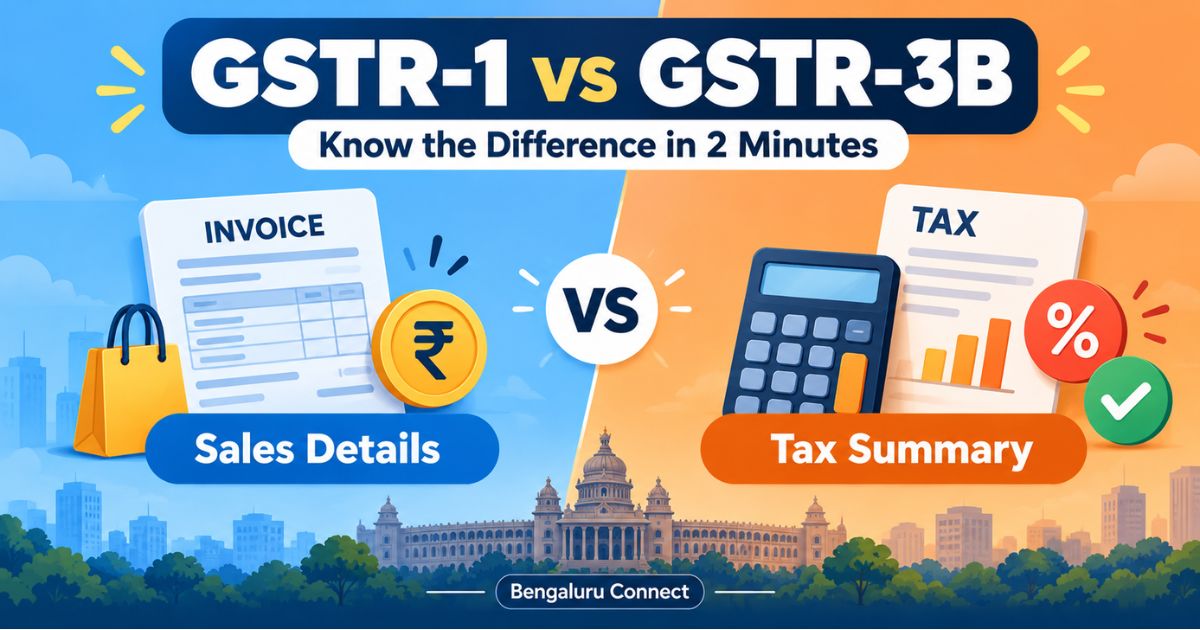
GSTR-1 reports the sales invoices you issued in a period, while GSTR-3B is a summary return where you declare your total tax liability, claim input tax credit and pay the tax. For regular monthly filers, GSTR-1 is generally due on the 11th and GSTR-3B on the 20th of the next month.
If you run a shop in Jayanagar, a cloud kitchen in HSR Layout or a freelance business from Whitefield, you will meet both returns every filing cycle. They look similar but do different jobs, and mixing them up leads to notices, blocked credit and late fees. This guide explains the GSTR-1 vs GSTR-3B difference in plain language.
Key Takeaways
GSTR-1 is a statement of your outward supplies (sales). No tax is paid through it.
GSTR-3B is a summary return. Tax is paid when you file it.
Both are mandatory every period, even if you had no sales (file a nil return).
Your GSTR-1 figures should match your GSTR-3B figures. Mismatches attract queries.
Small businesses under the QRMP scheme file quarterly returns but still pay tax monthly.
What Are the Main GST Return Types?
GST return types are the periodic statements a registered taxpayer files with the GST portal. Regular taxpayers file GSTR-1 and GSTR-3B. Composition dealers, e-commerce operators, input service distributors and others file different forms. If you have not yet registered, start with our guide to GST registration in Bangalore.
This article covers the two returns that most small businesses file the most often.
What Is GSTR-1?
GSTR-1 is a return that lists all outward supplies of goods and services made by a registered taxpayer in a month or quarter.
It includes:
Invoices issued to registered businesses (B2B)
Sales to unregistered customers (B2C), reported in summarised form for smaller invoices
Exports, credit notes and debit notes
Amendments to invoices reported in earlier periods
Your B2B customers see these invoice details in their own GST records, which is how they claim input tax credit. A wrong GSTR-1 can therefore hurt your customers, not just you.
What Is GSTR-3B?
GSTR-3B is a monthly (or quarterly under QRMP) summary return in which you declare outward tax liability, eligible input tax credit and the net tax payable.
This is where money moves. You use your input tax credit (ITC) to offset your output tax, then pay the balance in cash. The return also reports inward supplies liable to reverse charge and other summary details.
GSTR-1 vs GSTR-3B: Side-by-Side Comparison
Point | GSTR-1 | GSTR-3B |
|---|---|---|
What it reports | Invoice-level details of sales | Summary of sales, ITC and tax payable |
Tax payment | No payment made | Tax is paid while filing |
Input tax credit | Not claimed here | Claimed here |
Monthly due date (regular filers) | 11th of next month | 20th of next month |
Quarterly option (QRMP) | 13th of month after the quarter, with optional monthly invoice upload (IFF) | 22nd or 24th of month after the quarter, depending on state category |
Who benefits from accuracy | Your customers (their ITC depends on it) | You (your ITC and payment depend on it) |
Nil return needed? | Yes | Yes |
Due dates can be extended by government notification, so always check the GST portal for the current month.
What Are the GSTR-1 and GSTR-3B Due Dates?
For monthly filers
GSTR-1 due date: 11th of the following month
GSTR-3B due date: 20th of the following month
Example: for sales made in August, file GSTR-1 by 11 September and GSTR-3B by 20 September.
For QRMP scheme filers
The QRMP scheme (Quarterly Return Monthly Payment) is meant for small taxpayers. Under it, you file returns quarterly but pay tax every month using a payment challan. The scheme is available to taxpayers whose aggregate turnover is within the prescribed limit, which is currently stated as up to Rs 5 crore. Confirm the current limit on the portal.
GSTR-1 is filed quarterly by the 13th of the month after the quarter ends.
You can upload invoices monthly through the Invoice Furnishing Facility (IFF), so your customers get their credit sooner.
GSTR-3B is filed quarterly by the 22nd or 24th, depending on the state category. Karnataka has typically fallen in the 22nd group. Verify before you file.
What Is the GSTR-3B Late Fee?
Missing the deadline attracts a late fee for each return, plus interest on unpaid tax. The late fee is charged per day of delay and is split equally between Central GST and State GST.
Regular return: typically Rs 50 per day (Rs 25 CGST + Rs 25 SGST)
Nil return: typically Rs 20 per day (Rs 10 + Rs 10)
Maximum cap: varies by turnover slab and return type
Interest: charged on tax paid late, at the rate notified under GST law (commonly cited as 18% a year)
The same late fee structure applies to a delayed GSTR-1. Even a nil return filed late can cost you, so file on time even when there is nothing to report. Rates and caps change through notifications, so confirm current figures on the official portal or with a professional.
What Are the Most Common GSTR-1 and GSTR-3B Mistakes?
Treating the two returns as the same. Filing GSTR-3B and assuming GSTR-1 is "optional" or already covered is a frequent error.
Mismatched sales figures. The sales you show in GSTR-1 and GSTR-3B should reconcile. Differences often trigger system-generated notices.
Claiming ITC that does not appear in your records. Credit should be supported by your supplier's filing and a valid invoice. Compare with your auto-generated ITC statement (GSTR-2B) before filing.
Skipping nil returns. No sales in a month still means a return is due.
Wrong GSTIN or invoice details. A typo in a buyer's GSTIN means your customer cannot claim credit and may ask you to correct it.
Wrong HSN or tax rate. Using an incorrect rate leads to underpayment or overpayment. Check the rate for your goods or services.
Paying tax but not filing. A challan alone does not complete the return. Filing must be submitted separately.
Missing the QRMP monthly payment. Quarterly filers still owe tax every month. Forgetting this leads to interest.
Filing at the last minute. The portal gets slow near deadlines. Many Bengaluru traders learn this the hard way on the 20th.
Not keeping records. Keep invoices, purchase bills and payment proofs organised for each period.
How Should a Small Business in Bengaluru File Both Returns?
A simple monthly routine
Close your sales records for the month by the 5th.
Upload or verify invoice data and file GSTR-1 by the 11th.
Check your ITC statement (GSTR-2B) against purchase bills.
Calculate net tax: output tax minus eligible ITC.
Pay any balance and file GSTR-3B before the 20th.
Save acknowledgements and challans in a labelled folder.
Is the QRMP scheme right for you?
If you run a small shop, a tuition centre, a freelance practice or a home-based business with modest turnover, quarterly filing reduces the paperwork. The trade-off is that you must still pay tax monthly and keep clean records. If you also hold a Udyam certificate, see our guide to Udyam registration in Bangalore for how it fits into your business setup.
Conclusion: Get the GSTR-1 vs GSTR-3B Routine Right
The simplest way to remember GSTR-1 vs GSTR-3B is this: GSTR-1 tells the government who you sold to, and GSTR-3B tells it how much tax you owe and have paid. Keep both consistent, file before the deadline and reconcile your credit every month. These habits save you from penalties and notices.
If your filings feel confusing, or you are unsure whether the QRMP scheme suits you, it helps to talk to a professional early. You can talk to a GST consultant listed on Bengaluru Connect and get your returns set up properly.
This article is for general information and is not tax advice. Rules, due dates, late fees and limits can change by notification. Please confirm on the official GST portal or with a qualified chartered accountant or GST practitioner.

Frequently Asked Questions
Share this post
Comments (0)
No comments yet. Be the first to comment!
